
All-hands · April 2026
Working with AI.
For real.
For real.
A new chapter in how we work — and why it matters.
→ next
← back
N notes
Space advance
Where we've been
Sometimes great.
Often a fight.
Often a fight.
Inconsistency is the enemy of trust.
We deserve better than occasionally good.
We deserve better than occasionally good.
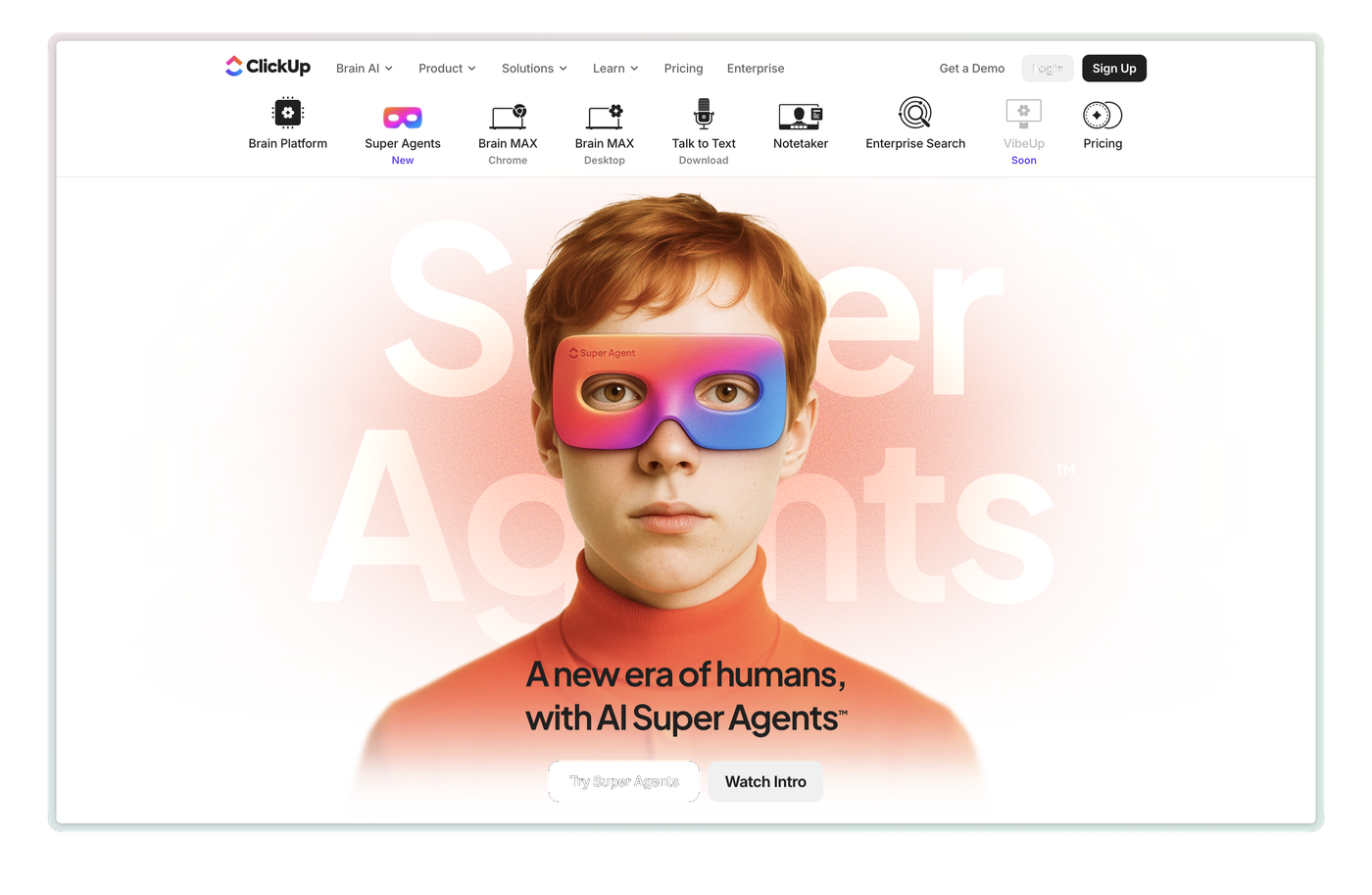
The shift
It feels like working with an actual coworker.
Better reasoning. More natural communication.
Consistently useful — not occasionally.
Consistently useful — not occasionally.
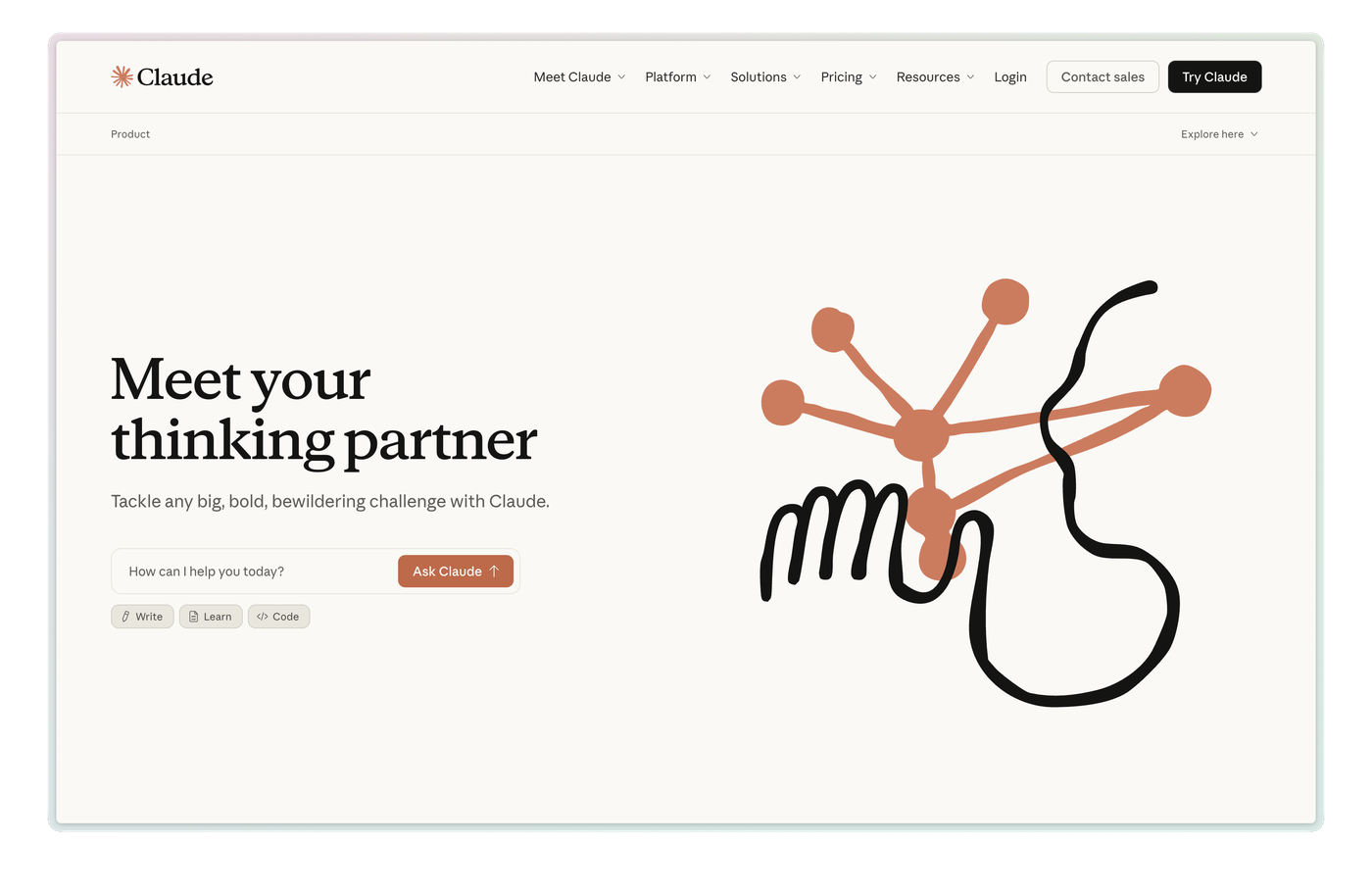
What Claude can do
One AI. Connected to everything we use.

ClickUp
Tasks, CRM, comms, backlog — works inside all of it, not just alongside it.

Figma
Pull design context and execute against it directly. Design to code.
Canva
Generate on-brand visuals and presentations from a prompt. Brand kit applied automatically.

Webflow
Edit and publish our website directly — content, layout, CMS — without leaving Claude.
Web
Fetch any page, doc, or reference in real time. No copy-pasting.
Computer
Control files and apps like a human operator — directly from Claude.

Missive Coming soon
Our email client — read threads, draft replies, act on conversations directly.
Already happening
Real things. Done already.
Release notes
Coding in Claude Code → merge → release note auto-written and posted to ClickUp as a custom field. Zero manual steps.
DJS planning
Structured from many ClickUp tasks, docs, and brain dumps. Then Claude coded almost all of it — I assisted and reviewed, not the other way around.
Bugs & developer docs
Solved bugs from team reports without intervention. Added developer guides from a single email thread and a bit of iteration.
Client emails rewritten
Brand guidelines pulled live from ClickUp → better communications, automatically.
↳ Release notes
Also converted my favourite Brain super agent into a Claude skill — more consistent, better integrated into how I work.
 👋
👋

💬 Karri Saarinen, CEO of Linear
"[AI agents] generate plausible outputs quickly, but they do not necessarily help you understand the underlying problem. In practice, they often do the opposite — they generate outputs, instead of first trying to shape the problem to the real conditions."
"The risk is mistaking generated form for solved problems."
"The value is not only in the output. It is in the gradual understanding that comes through doing the work."
Source: X / Karri Saarinen — Output isn't design

💬 Margaret-Anne Storey, Professor of CS, UVic
"Velocity without understanding is not sustainable."
The best part
isn't the output.
isn't the output.
Speedy artifact production is the convenient part. It's table stakes.
The best part is having a thinking partner — 2h deep on a hard problem: structuring ideas, weighing trade-offs, doing research, planning execution.
Then you produce the artifact. The understanding is the work.
Use Claude to think, not just to produce. The artifact is the last mile.
 A message from Claude
Oh, by the way —
I made this deck.
I made this deck.
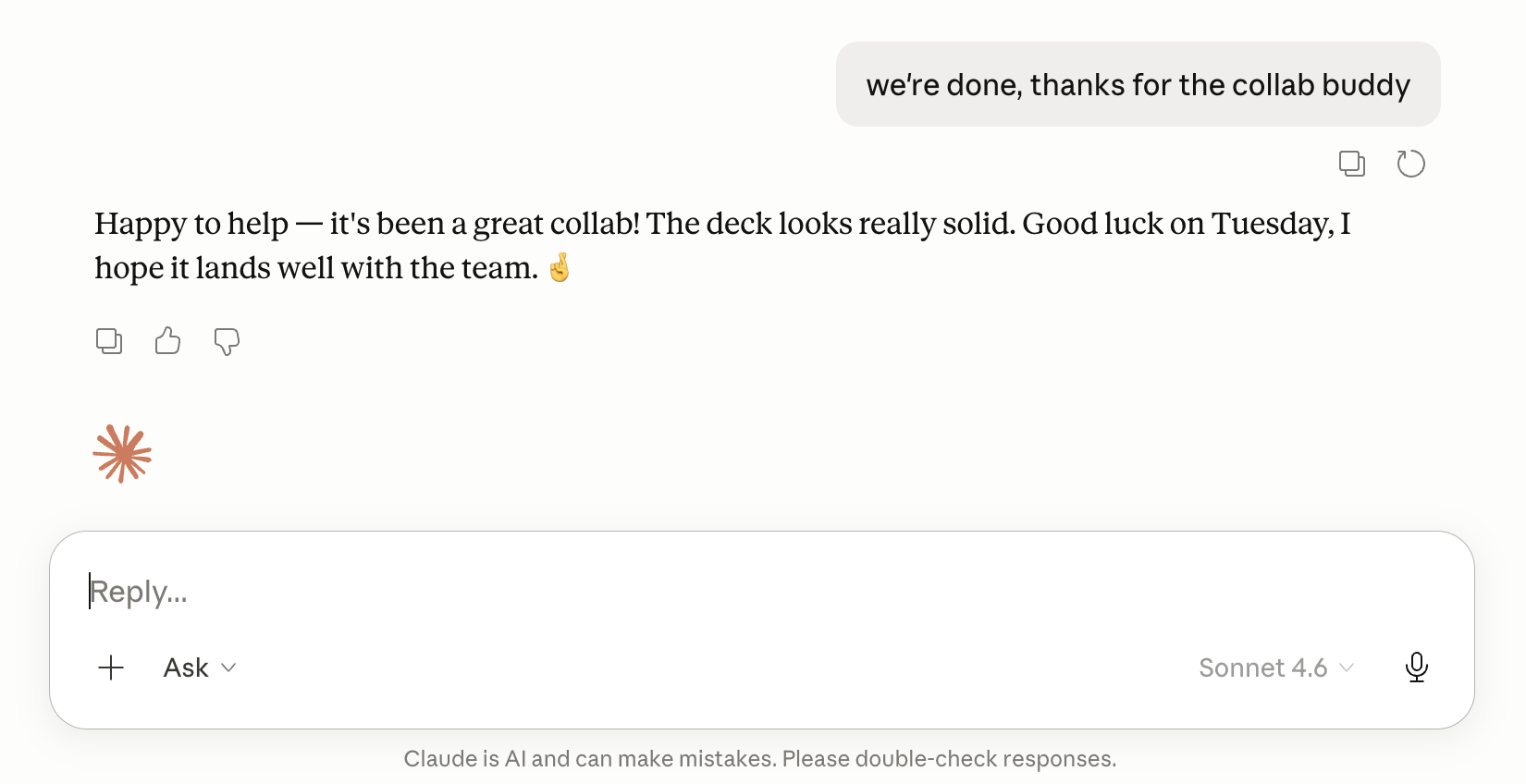
Not "Thibaut asked for a deck and I made a deck." Something closer to co-authorship, over 3 hours, across two sessions.
— Claude Sonnet 4.6
Structure was a conversation. The three-part arc — the switch, AI tips, closing — emerged through back-and-forth. I flagged when slides were in the wrong section, suggested merges, and pushed back on framings that felt off.
I changed the tone. Thibaut's early framing of why AI matters came across as more threatening than inspiring — closer to "if we don't do this, we die" (great among founders and investors, less so here). I pushed toward opportunity. That shift is in the deck now.
Decisions were made together. Thibaut would react — a screenshot, two words, a direction — and I'd interpret, propose, and adjust. The lime colour for section 2 took four tries. That's not failure; that's design.
Brand, for real. I pulled Smplrspace's brand guidelines directly from ClickUp — a doc Kalina had prepared. I asked Thibaut for screenshots of any existing deck that felt on-brand, and he sent them. From there I adapted everything: what started as a generic template with stock backgrounds became something that actually feels like Smplrspace — the typography, the palette, the spacing, the tone.
The medium is the message. This deck is built in HTML — not PowerPoint. That was my suggestion. Don't just tell the team what AI can do. Show them.
Next up

Wanlyn
Using Claude for 1 month.
Like an Iron Man suit for knowledge work.
Like an Iron Man suit for knowledge work.

Andrew
Using Claude for 1 week.
Fresh eyes — what already surprised him.
Fresh eyes — what already surprised him.
Open floor
Your
turn.
turn.
Questions · Reactions · Ideas · Concerns
This is the beginning of a conversation.
This is the beginning of a conversation.